As an Amazon Associate, we earn from qualifying purchases. This post may contain affiliate links, which means we may earn a small commission if you purchase through our links, at no extra cost to you.
Introduction
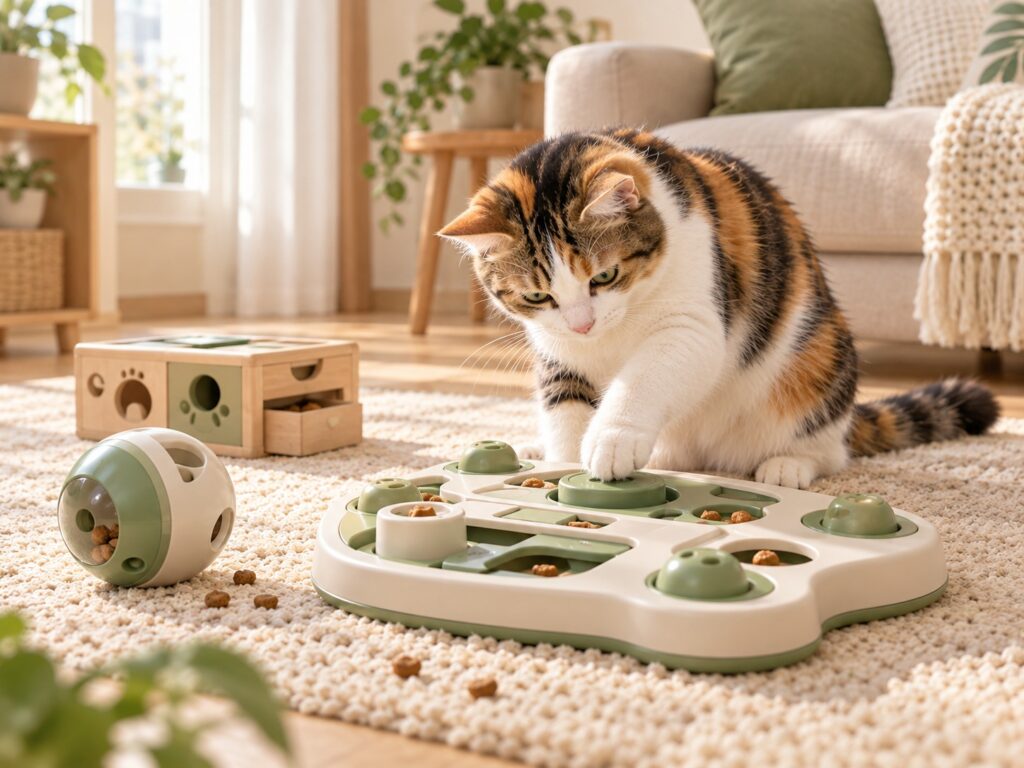
Some cats can spend a surprising amount of time figuring out how to reach one small piece of food.
A paw under a lid, a nose against a slider, or a few determined taps on a rolling feeder can turn an ordinary snack into a much more engaging activity.
That is exactly why I like puzzle toys for indoor cats.
The best cat puzzle toys encourage cats to paw, push, slide, roll, search, and problem-solve instead of simply waiting for food to appear in a bowl.
They can be especially useful as part of an indoor enrichment routine because different puzzle designs encourage different types of interaction. Some are simple enough for first-time puzzle users, while others require several steps before the reward becomes available.
In this guide, I selected six different puzzle styles rather than recommending several nearly identical treat boards.
The goal is to help you match the difficulty and movement style to the way your cat naturally likes to explore.
If you are still comparing different play styles, our guide to the best cat toys for indoor cats also covers wand toys, tunnels, automatic toys, catnip toys, and other enrichment options.
Our Top Picks
| Category | Product | Puzzle Style | Best For |
|---|---|---|---|
| Best Overall | TRIXIE Activity Fun Board 5-in-1 | Multi-station board | Cats that enjoy variety |
| Best for Beginners | PetSafe SlimCat Interactive Feeder | Rolling treat dispenser | First-time puzzle users |
| Best Sliding Puzzle | Catstages Buggin’ Out Puzzle & Play | Sliding and swiveling board | Paw-focused problem solving |
| Best Advanced Puzzle | Catstages Rainy Day Puzzle & Play | Multi-step Level 3 board | Experienced puzzle users |
| Best Box-Style Puzzle | Catstages Kitty Cube Treat Puzzle | Cube and hidden-food search | Cats that like reaching into openings |
| Best Hunting Puzzle | Doc & Phoebe’s Indoor Hunting Feeder | Hidden foraging feeders | Cats that enjoy searching around the home |
How We Chose These Cat Puzzle Toys
For this guide, I focused on puzzle toys that offer genuinely different ways to interact with food or treats.
I compared:
- Puzzle difficulty
- Type of movement required
- Food or treat compatibility
- Stability during use
- Cleaning and maintenance
- Adjustability
- Suitability for beginners or experienced puzzle users
- Safety and supervision needs
These are research-based product recommendations rather than claims of independent hands-on testing.
Always check the current product instructions and retailer listing before purchasing, since materials, dimensions, colors, and included parts can change over time.
6 Best Cat Puzzle Toys for Indoor Enrichment
1. Best Overall: TRIXIE Activity Fun Board 5-in-1
Best For:
Cats that enjoy several different puzzle styles
Puzzle Type:
Multi-station activity board
Why We Like It
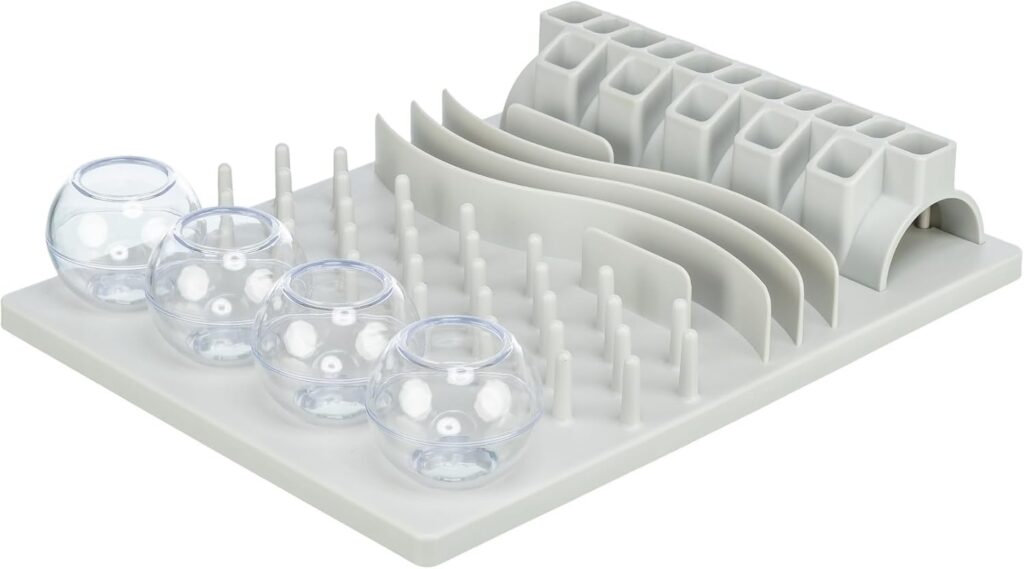
The TRIXIE Activity Fun Board is my top overall choice because it does not rely on only one puzzle mechanism.
Instead, the board includes five different activity areas that ask your cat to use different movements to reach food or treats.
Some sections encourage pawing into openings, while others require reaching, pushing, or working around obstacles.
That variety makes it particularly useful for cats that quickly learn a single puzzle pattern.
Rather than immediately buying a more difficult toy when your cat masters one movement, you can offer several different challenges on the same board.
Key Features
- Five different puzzle modules
- Several pawing and reaching challenges
- Can be used with dry food or treats
- Non-slip rubber feet
- Plastic construction
- Includes training instructions
- Suitable for different experience levels
Things to Consider
This is a relatively large stationary board compared with a rolling feeder or compact treat toy.
It also contains several different sections, so cleaning can take a little longer than washing one simple bowl.
For a cat completely new to puzzles, start with the easiest sections and leave some food clearly visible.
Recommended For: Cats that enjoy variety and owners who want one puzzle with several different challenges.
2. Best for Beginners: PetSafe SlimCat Interactive Feeder
Best For:
Cats trying a food puzzle for the first time
Puzzle Type:
Rolling food-dispensing ball
Why We Like It
Not every cat should begin with a board full of sliders, lids, and hidden compartments.
The PetSafe SlimCat uses a much simpler concept.
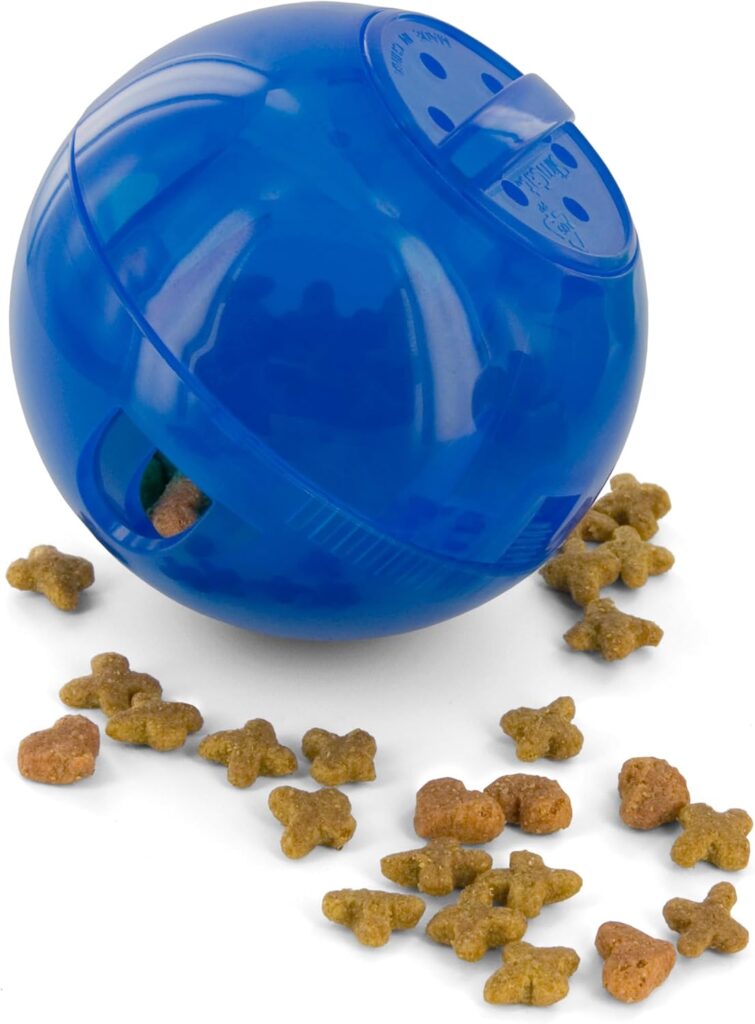
You place dry food or treats inside the ball, and food falls through the openings as your cat pushes and rolls it across the floor.
The openings can be adjusted, which makes it easier to start with a generous food release and gradually make the activity more challenging.
That simplicity makes this one of the easiest ways to introduce the basic idea that interacting with an object can produce a food reward.
Key Features
- Rolling food dispenser
- Adjustable food openings
- Holds up to approximately 2/3 cup
- Works with dry food or treats
- BPA-free plastic
- Top-rack dishwasher safe
- Combines movement with food retrieval
Things to Consider
Because this toy rolls, it can disappear under furniture.
Use it in a clear play area if you have low sofas, cabinets, or appliances.
It is designed primarily for dry food, so it is not the right puzzle for wet food.
Start with the openings relatively wide so your cat learns how the toy works before increasing the difficulty.
Recommended For: Cats that are completely new to puzzle feeding.
3. Best Sliding Puzzle: Catstages Buggin’ Out Puzzle & Play
Best For:
Cats that like using their paws to move objects
Puzzle Type:
Sliding and swiveling treat board
Why We Like It
Once your cat understands simple food puzzles, a stationary board introduces a different kind of problem-solving.
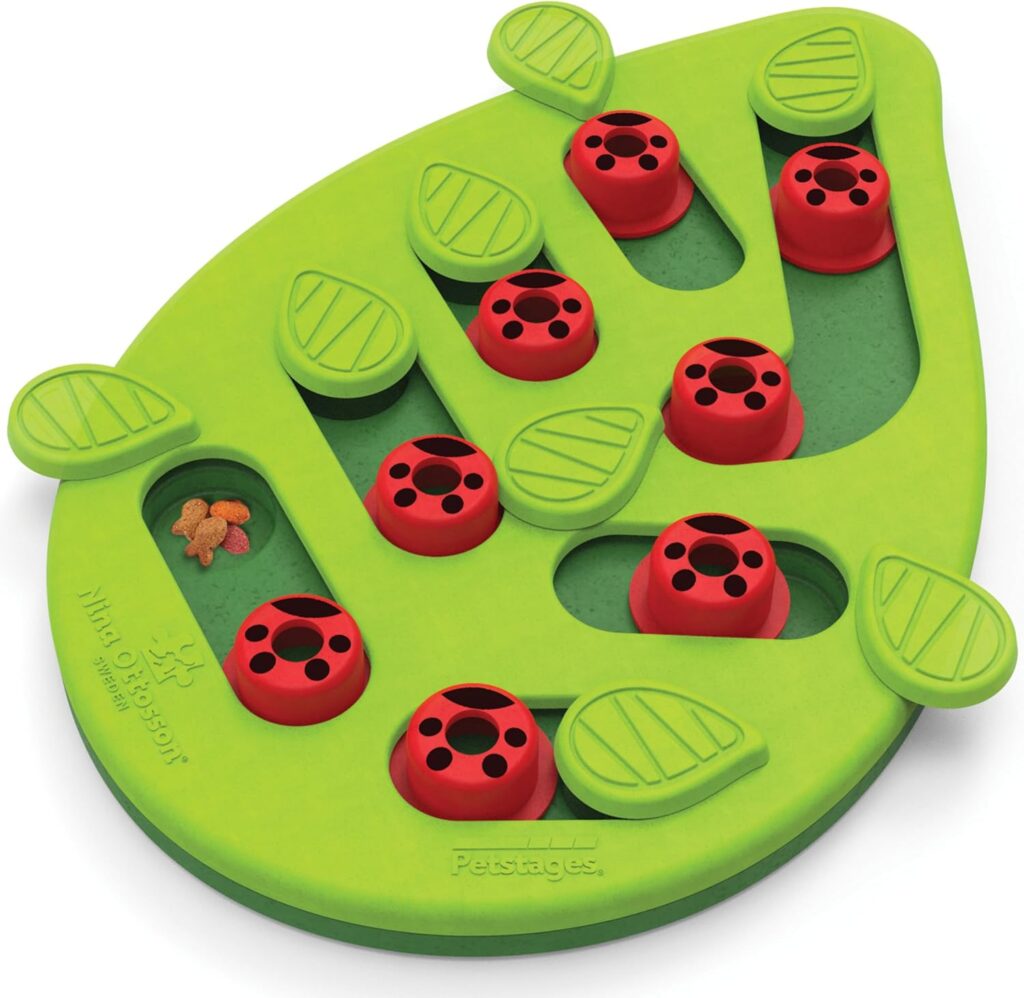
The Catstages Buggin’ Out uses movable pieces that cats must paw, push, and swivel to uncover hidden food compartments.
Instead of chasing a rolling object, your cat stays in one place and works out how each section opens.
This makes it a good next step for cats that already understand that food can be hidden inside a toy.
Key Features
- Multiple hidden treat compartments
- Sliding and swiveling puzzle pieces
- Stationary board design
- Designed for paw-based problem solving
- Can be used for treats or portions of dry food
- Suitable for indoor enrichment
Things to Consider
Do not make every compartment difficult on the first attempt.
Leave several rewards easy to reach so your cat learns that interacting with the puzzle is worthwhile.
If your cat repeatedly walks away, the puzzle may simply be too difficult at that stage.
Reduce the challenge before assuming your cat does not enjoy puzzle toys.
Recommended For: Cats ready to move beyond simple rolling food dispensers.
4. Best Advanced Puzzle: Catstages Rainy Day Puzzle & Play
Best For:
Cats that already solve easier puzzles quickly
Puzzle Type:
Advanced multi-step treat board

Why We Like It
Some cats become extremely efficient once they understand sliders and treat compartments.
For those cats, the Catstages Rainy Day provides a more challenging step.
It is designed as a higher-difficulty puzzle and uses several movable sections that require more deliberate manipulation before the hidden food becomes accessible.
That makes it more appropriate for cats that already understand basic puzzle mechanics rather than cats seeing their first food puzzle.
Key Features
- Level 3 puzzle design
- Multiple treat compartments
- Several different movable elements
- Designed for more experienced puzzle users
- Stationary board format
- Can be used with treats or dry food
Things to Consider
More difficult does not automatically mean better.
A puzzle should make your cat work a little longer—not cause them to stare at it, become frustrated, or walk away.
If your cat struggles, leave some sections open or return temporarily to an easier puzzle.
Recommended For: Cats that already solve beginner and intermediate puzzles confidently.
5. Best Box-Style Puzzle: Catstages Kitty Cube Treat Puzzle
Best For:
Cats that naturally investigate boxes, holes, and hidden spaces
Puzzle Type:
Cube-style treat puzzle
Why We Like It
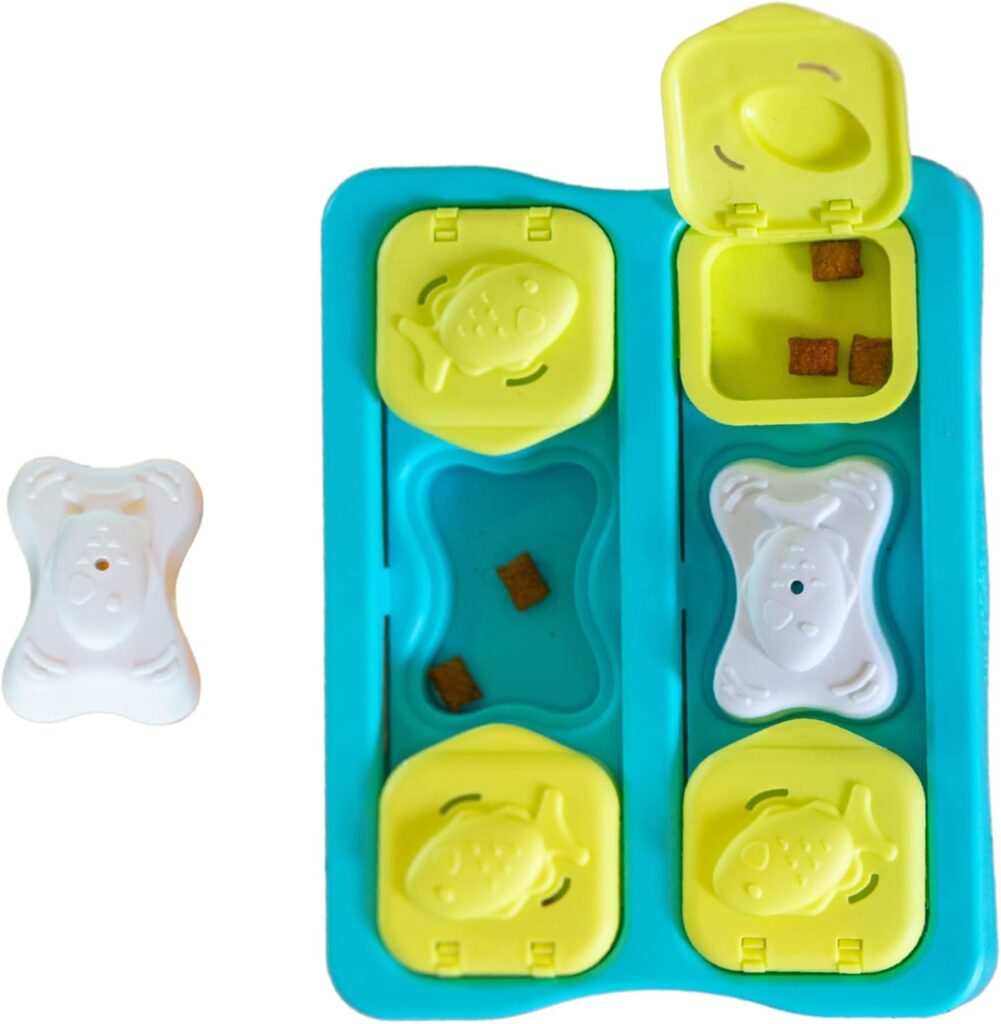
Some cats are much more interested in reaching into spaces than sliding pieces around a flat board.
The Kitty Cube provides that different experience.
Instead of presenting every challenge on a flat surface, the cube encourages cats to investigate openings and work out how to retrieve hidden food.
This makes it a useful rotation option if your cat already has one or two traditional puzzle boards.
Changing the shape of the puzzle can make a familiar reward feel new again.
Key Features
- Cube-style puzzle design
- Hidden food or treat areas
- Encourages reaching and searching
- Compact format
- Designed for indoor mental enrichment
- Useful as a rotation puzzle
Things to Consider
Watch how your cat interacts with the openings before increasing the difficulty.
Cats with limited paw mobility or cats that strongly prefer shallow puzzle surfaces may find a cube-style toy less intuitive.
Keep the puzzle clean if food regularly comes into contact with internal surfaces.
Recommended For: Curious cats that enjoy investigating boxes and openings.
6. Best Hunting Puzzle: Doc & Phoebe’s Indoor Hunting Feeder
Best For:
Cats that enjoy searching for food in different locations
Puzzle Type:
Hide-and-seek foraging feeder

Why We Like It
Most puzzle toys ask a cat to solve a problem in one fixed location.
The Doc & Phoebe’s Indoor Hunting Feeder changes that approach by letting you hide several small feeder “prey” around the home.
Your cat first has to locate the feeder and then work to retrieve the food inside.
This makes the experience closer to a room-to-room searching activity rather than a stationary tabletop puzzle.
It can also make a useful change for cats that have become very efficient at traditional puzzle boards.
Key Features
- Multiple small hunting feeders
- Designed to be hidden around the home
- Encourages searching and foraging
- Works with dry food
- Combines movement with food retrieval
- Can be used as part of a daily feeding routine
Things to Consider
You need to remember where you place each feeder.
Do not leave old food hidden around the home, and inspect the fabric or outer material regularly if your cat likes to chew.
For multi-cat households, separate feeding areas may be necessary if one cat consistently finds and guards all the feeders.
Recommended For: Food-motivated cats that enjoy searching and exploring.
How to Choose a Cat Puzzle Toy
The hardest puzzle is not automatically the best puzzle.
A good puzzle should make your cat think and work without making the reward feel impossible.
1. Start With the Right Difficulty
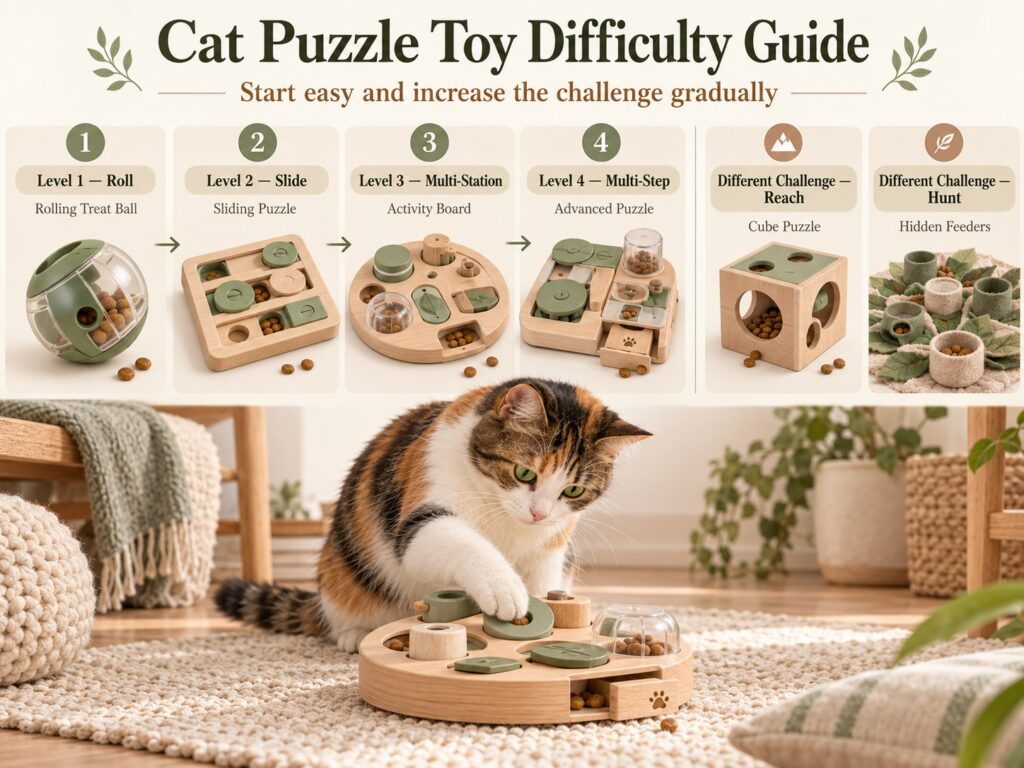
For a first puzzle, begin with a simple rolling feeder or a board with several rewards already visible.
Once your cat understands the basic idea, you can gradually introduce:
Rolling → Sliding → Lifting → Multi-Step → Searching
Moving through puzzle styles gradually is usually more useful than starting with the most complicated product you can find.
2. Match the Puzzle to How Your Cat Uses Their Paws
Different cats solve problems differently.
Some immediately push objects.
Others scoop food out with one paw.
Some use their nose first.
And some prefer searching around the room instead of sitting in front of a board.
Watch how your cat already interacts with toys and food before choosing a puzzle.
3. Decide Whether You Want a Toy or a Feeder
Some puzzle toys work best with a few treats.
Others can hold part of a normal dry-food meal.
If slowing down meals is your main goal rather than providing mental enrichment, our guide to slow feeder bowls for cats compares dedicated feeding options for different food types and eating habits.
4. Use Food Your Cat Actually Wants
A beautifully designed puzzle will not be very interesting if the reward inside is not motivating.
You can use part of your cat’s regular dry-food portion instead of adding extra treats every time.
This also makes it easier to use puzzle play as part of the normal routine rather than constantly adding extra snacks.
5. Consider Cleaning
Food puzzles need regular cleaning.
Before buying, look at:
- Deep corners
- Narrow tubes
- Movable parts
- Removable pieces
- Dishwasher instructions
- Areas where crumbs can collect
Simpler designs are often easier to maintain.
6. Consider Stability
A lightweight board on a smooth floor may slide across the room before your cat actually solves it.
Non-slip feet or a feeding mat underneath can help keep stationary puzzles in place.
Rolling puzzles are different—they need enough clear floor space to move.
Cat Puzzle Toy Difficulty Guide
A simple way to think about puzzle difficulty is:
| Level | Puzzle Style | Good Starting Point |
|---|---|---|
| Beginner | Rolling / visible reward | SlimCat |
| Easy–Moderate | Sliding pieces | Buggin’ Out |
| Moderate | Multiple puzzle stations | TRIXIE Fun Board |
| Advanced | Multi-step covered compartments | Rainy Day |
| Different Challenge | Cube / reaching | Kitty Cube |
| Foraging Challenge | Search around the home | Indoor Hunting Feeder |
Do not worry if your cat never reaches the “advanced” level.
The goal is enrichment, not proving how difficult a puzzle your cat can solve.
How to Introduce a Puzzle Toy to Your Cat
Step 1: Let Your Cat Explore It
Place the puzzle on the floor without making every compartment difficult.
Let your cat sniff and investigate.
Step 2: Make the First Reward Easy
Place several pieces of food where they are visible or easy to retrieve.
Your cat needs to learn:
Touch the puzzle → food appears.
Step 3: Demonstrate One Movement
Move one slider or roll the feeder once while your cat is watching.
Do not solve the entire puzzle for them.
Step 4: Increase Difficulty Slowly
Once your cat can retrieve the easy rewards confidently, close more compartments or reduce the dispenser opening.
Step 5: Stop Before Frustration
If your cat walks away repeatedly, paws aggressively without success, or loses interest, make the puzzle easier again.
Puzzle play should feel rewarding.
A Simple Puzzle Toy Rotation
You do not need several puzzles available at the same time.
For example:
| Day | Puzzle Activity |
|---|---|
| Monday | Rolling feeder |
| Tuesday | Wand play |
| Wednesday | Sliding puzzle |
| Thursday | Automatic toy |
| Friday | Multi-station puzzle |
| Saturday | Hunting feeder |
| Sunday | Favorite simple toy |
Rotating activities can help keep familiar puzzles from becoming too predictable.
Puzzle Toy Safety Tips
Puzzle toys are usually relatively simple, but they still need regular inspection.
Check that:
- Movable pieces remain securely attached
- Plastic is not cracked
- Fabric is not torn
- Food is removed after use
- Small pieces cannot be chewed off
- The puzzle is stable enough for the intended activity
For a broader toy-safety checklist, see our guide on how to choose safe cat toys.
FAQ
Are puzzle toys good for indoor cats?
Puzzle toys can add problem-solving, searching, and food-based enrichment to an indoor routine. They work best alongside other activities such as wand play, climbing, scratching, resting spots, and interactive play with people.
What is the best puzzle toy for a beginner cat?
A simple rolling food dispenser such as the PetSafe SlimCat is an easy starting point because the relationship between moving the toy and receiving food is relatively straightforward.
How difficult should a cat puzzle be?
A puzzle should require effort without causing repeated frustration. If your cat cannot retrieve any reward after several attempts, make the puzzle easier.
Can I use regular cat food in puzzle toys?
Many food puzzles can be used with dry food, although you should always follow the manufacturer’s instructions. Using part of a normal meal can be a practical alternative to adding extra treats.
Can puzzle toys slow down eating?
Some food puzzles make cats work for individual pieces of food and may extend mealtime. If eating speed is your primary concern, a dedicated slow feeder may be more practical.
How often should cats use puzzle toys?
There is no fixed schedule. Some cats enjoy short puzzle sessions daily, while others respond better when puzzles are rotated every few days.
What if my cat ignores the puzzle?
Start with visible food, reduce the difficulty, and demonstrate one simple movement. Some cats need several introductions before they understand the game.
Final Thoughts
The best cat puzzle toys are not necessarily the most complicated ones.
The right puzzle is the one that matches your cat’s current skill level and encourages them to keep trying without becoming frustrated.
For beginners, a rolling food dispenser can make the concept easy to understand.
Cats that enjoy pawing and sliding may prefer Buggin’ Out or the TRIXIE Fun Board, while experienced puzzle users may be ready for Rainy Day.
And for cats that enjoy searching around the home, a hunting feeder introduces a completely different challenge.
Puzzle toys are only one part of indoor enrichment. If your cat also enjoys movement-based play, our guide to the best automatic cat toys for indoor cats compares rolling balls, moving mice, flapping birds, hidden feathers, and other electronic play styles. If your cat prefers scent-driven play instead of food puzzles, our guide to the best catnip toys includes several plush, kicker, mouse, and chew options.
Start simple, make success easy at first, and increase the challenge only when your cat is ready.
Related HavenTails Guides
Best Cat Toys for Indoor Cats
Compare several toy styles for chasing, hiding, problem-solving, catnip play, and everyday indoor enrichment.
Best Automatic Cat Toys for Indoor Cats
Explore electronic toys including rolling balls, concealed feathers, flapping birds, butterflies, and moving mouse toys.
Best Slow Feeder Bowls for Cats
Compare feeding options designed to slow down meals using ridges, obstacles, lick surfaces, and portion-friendly designs.
How to Choose Safe Cat Toys
Learn what to check for with materials, small parts, strings, attachments, cleaning, and supervised play.